
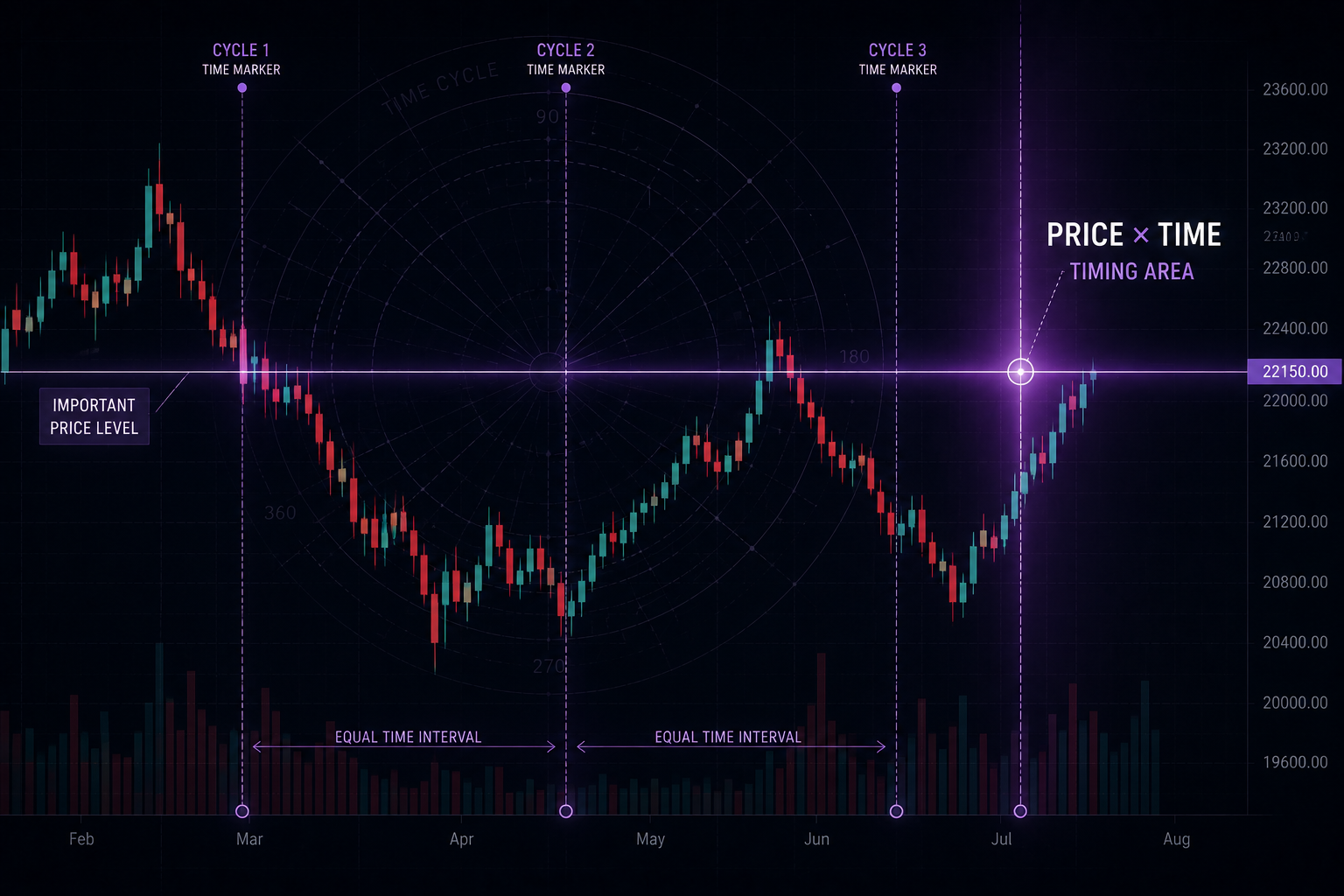
What Is Market Timing? Understanding Price, Time & Cycles
Market timing is the study of when important market movements may develop.
Most beginners naturally focus on price: where to enter, where support exists or where resistance may appear. Market-timing analysis adds another important dimension: time.
Price vs Time
Consider these two questions:
Price Analysis: At what level should we observe the market?
Time Analysis: During what period should we pay closer attention to market behaviour?
Studying both can provide a more structured view of the market.
How Are Market Cycles Used?
Financial markets move through different phases. Trends develop, momentum slows, consolidation occurs and new movements begin.
Market-timing analysis studies these movements by observing:
- Previous swing durations
- Important market highs and lows
- Daily and weekly cycles
- Monthly cycles
- Repeating time intervals
- Time clusters
When several time relationships appear around a similar period, traders may identify it as an area that deserves additional observation.
Market Timing Is Not Prediction
An important distinction is that a timing area does not automatically mean the market will reverse.
Price action and market structure still need to confirm what is actually happening.
For example, if a time cycle completes while price is approaching an important market level, a trader can observe the area more carefully rather than immediately taking a position.
A Structured Approach
Market timing becomes more meaningful when combined with:
Time + Price + Market Structure + Risk Management
No individual component should be treated as a guaranteed signal.
Final Thoughts
Understanding time can provide traders with a different perspective on market behaviour. Instead of focusing exclusively on where price is moving, market-timing analysis encourages traders to study when important market activity may develop.
Explore our Market Timing courses to learn these concepts through structured chart-based education.
Disclaimer: This content is for educational purposes only and does not constitute financial or investment advice.