
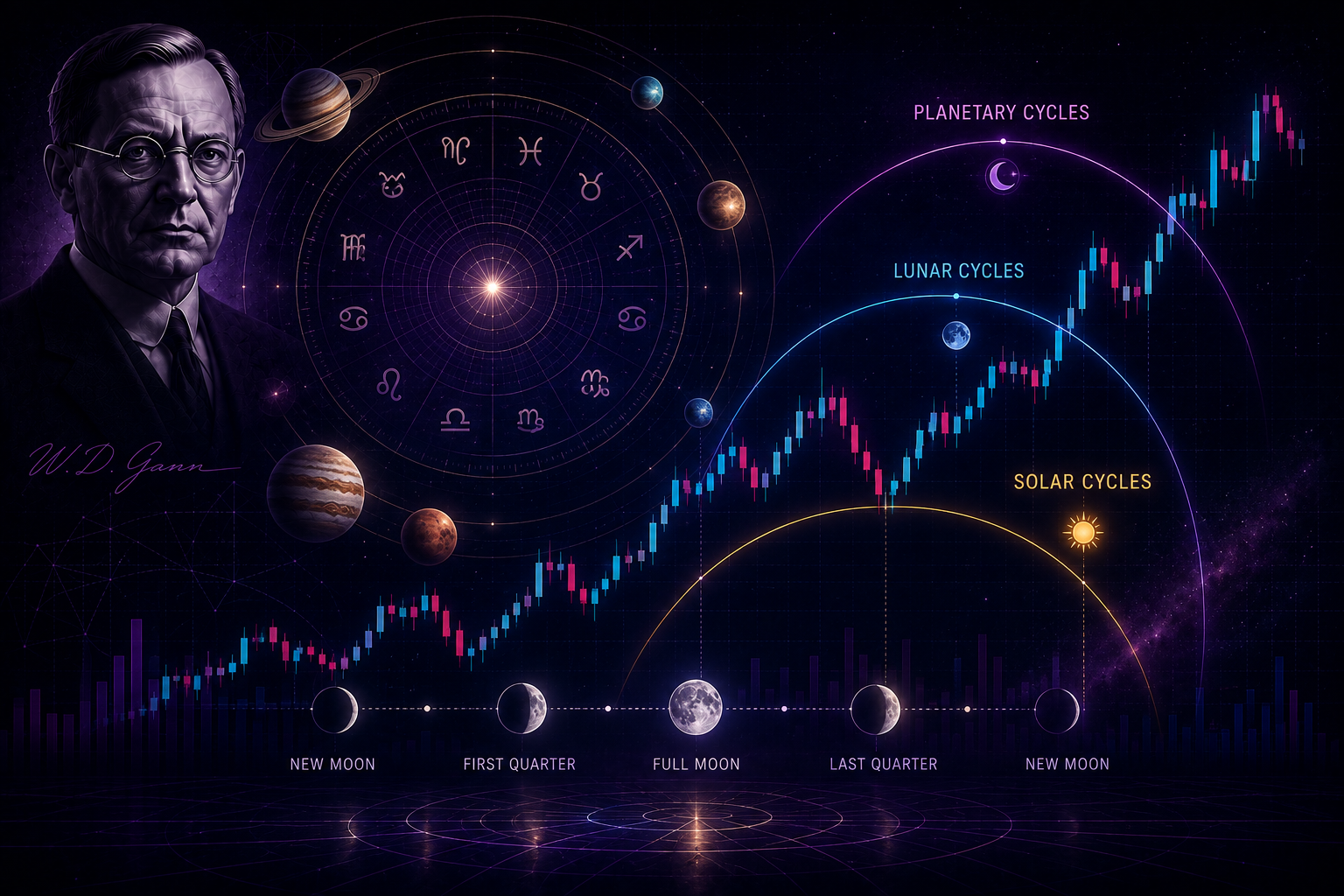
Planetary Cycles in Trading: Understanding Their Role in Market Timing
Planetary Cycle analysis is a specialised approach to studying time and recurring astronomical cycles in relation to financial markets.
Rather than treating planetary movements as direct trading signals, this approach studies whether recurring astronomical periods show relationships with historical market behaviour.
What Are Planetary Cycles?
Planets move through measurable and repeating cycles. Astro-based market analysis studies these cycles from a timing perspective.
Commonly studied astronomical bodies may include:
- Sun
- Moon
- Mercury
- Venus
- Mars
- Jupiter
- Saturn
Because each follows a different cycle, they can be studied across different time periods.
How Are Planetary Cycles Studied?
An analyst may compare planetary cycles with previous market highs, lows or periods of significant market activity.
If similar timing relationships appear historically, an upcoming period may be marked for closer market observation.
However, a planetary cycle itself does not determine whether the market will move upward or downward.
Timing Requires Market Confirmation
Planetary analysis primarily focuses on when a period may become interesting rather than predicting an exact price or direction.
A structured approach can involve:
Planetary Timing -> Market Period -> Price Behaviour -> Confirmation
Actual price action and market structure therefore remain important parts of the analysis.
Final Thoughts
Planetary Cycle analysis provides an alternative way of studying time and recurring cycles in financial markets.
It should be approached as a market-timing framework rather than a guaranteed forecasting method. Combining timing concepts with market observation and disciplined risk management creates a more structured approach.
Disclaimer: This content is for educational purposes only and should not be considered financial, investment or trading advice.